Persephone's Power
A modern retelling of an ancient myth

Before we being: I wrote this version of Persephone’s story in 2022 because so many people enjoyed my verbal retellings. Please share it with people, but credit it to me. I hold the copyright.
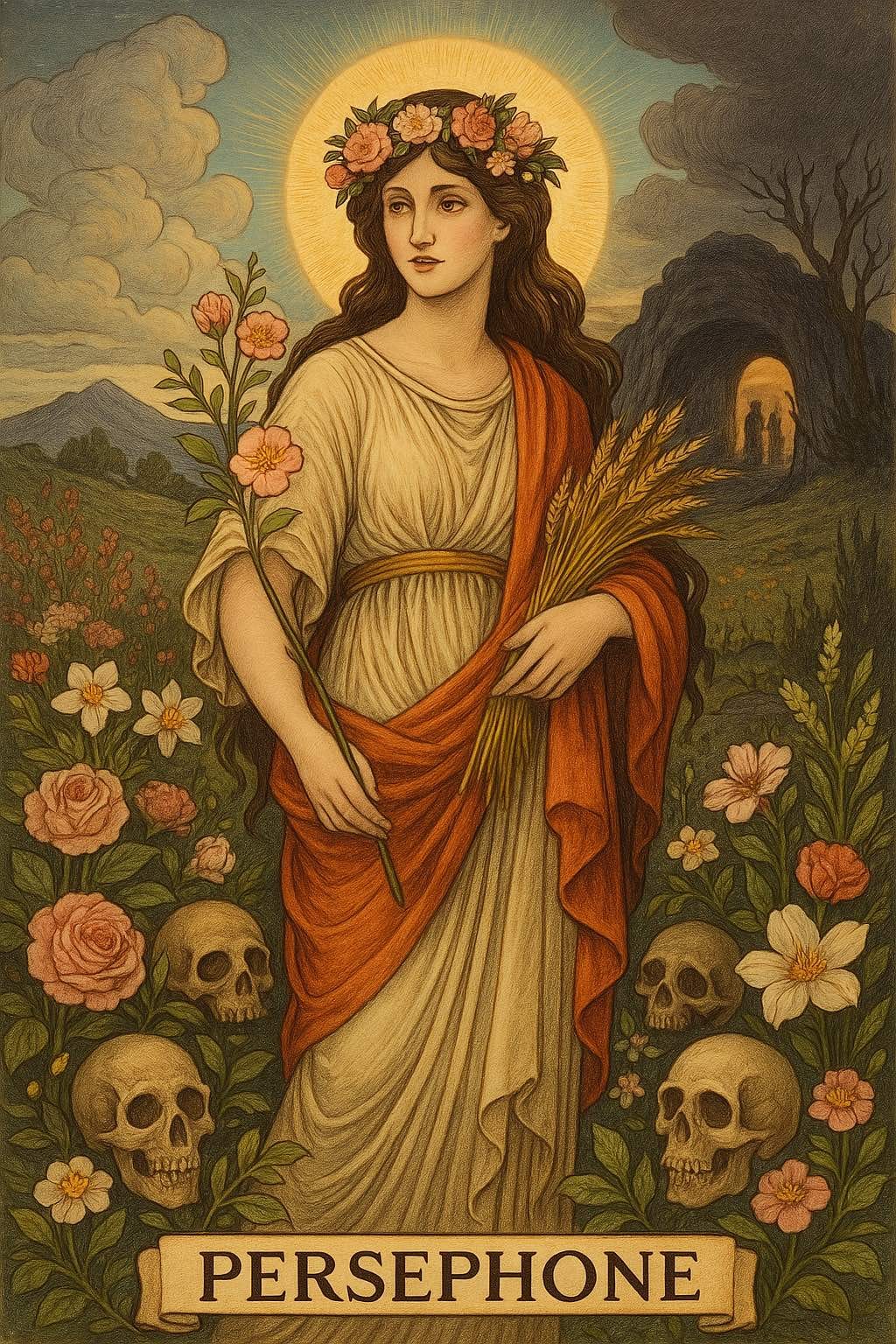
Kore is the goddess of flowers—beautiful and soft, radiating from her center, perfumed and enticing. Not enticing like a seductress, but inherently attractive, unfurling in her season, innocent and potent. She is the time of pollination, of youth before first fruit. It is relevant that Kore’s name is the same as an apple’s core: the star-shaped chambers where the seeds are protected, encased, kept dormant.
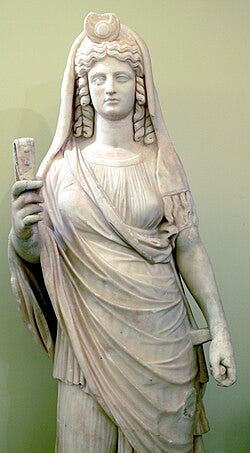
Demeter, Kore’s mother, is the goddess of grain. She is a busy woman. She travels all over the world, ensuring the ripening of annual storage crops which sustain civilization. She has a good job, and she wanted children, so she didn’t let a little thing like being single stop her. She can afford good childcare!
Demeter enlisted the help of nymphs, female nature spirits who cannot exist if separated from their waters, soils, trees, and ravines. Kore’s best friends were all nymphs who lived in a specific flowery meadow, bounded by a peaceful river of clean water, with a border of fruit trees holding back the forests and mountains.
Confident that her precious daughter was safe, protected, encased by the constant attention of her nymph friends, Demeter worked to sustain civilization with abundant crops of grain. Because this is prehistory we’re talking about, grain-ripening was a year-round vocation.
In the flowery meadow where Kore dwelt, springtime blossoms were abundant year-round as well. One day, Kore felt just a little bit bored with the constant sameness. She wasn’t a child anymore, but she wasn’t quite sure what came next. She wandered a little farther from her friends as her eyes explored the field’s edges, and she sighed.
Suddenly, Kore saw something she’d never noticed before: a crack in a rock, right behind a flowering quince bush. The black opening was mostly obscured by the shrubby quince’s bright red blossoms, so Kore crept closer to peer inside. It was a little cave, just large enough for her to enter, and it seemed to continue as a tunnel into the mountainside. She looked around to see if any nymphs noticed her, but they were all complacently laughing and talking on the other side of the meadow.
“I’ll just crawl under the bush and peek inside,” thought Kore. And she did.
“It’s not so dark after all. I’ll just go into the cave and see what’s there,” thought Kore. And she did.
“I wonder where this tunnel goes? I’ll just follow it a little way so I can see,” thought Kore. And she did.
“This tunnel is getting smaller, but I still fit. It probably ends soon. I’ll find out,” thought Kore. And she did.
The tunnel ended in a very tight spot where Kore could neither turn around nor back out. Frantic, she cried for help. The nymphs were too far away, out in the bright sunshine among the flowers. They couldn’t hear her. But someone else heard her. Someone underground. And he helped her—in a way. He caused the floor of the tunnel to collapse so Kore could escape—downward.
Kore landed in a large underground chamber with a throne at one end and many tunnels opening out around the edges. On the throne sat Hades, the king of the Underworld. He was surprised to see Kore, but also pleased. When he found out who she was and how she came to be there, he begged her to stay.
“You might like it here, once you get to know us,” wheedled Hades. “All the wealth of the world comes from my kingdom: gold, silver, gemstones, and fossil fuels. The dead dwell here. Many of them are very intelligent, creative artists, loving parents, or have other life experiences that are endlessly fascinating. The dead carry much wisdom and can hold interesting conversations. Plus, I like board games. I have an entire collection. Do you like Checkers? Or Blokus? Dungeons and Dragons? Oh, I know, Forbidden Island! It’s a cooperative game!”
Hades seemed nice, but Kore was out of her element. She didn’t know how to judge any of these completely new experiences. So she wasn’t comforted.
“I don’t like it here! It’s dark and cold and there’s a lot of shadowy wraiths wandering around! Your throne is black and your face is white and I don’t see a single flower anywhere! I want my mother!” Kore burst into tears.
Hades awkwardly patted her shoulder and glanced desperately around the room. Various wraiths shrugged helplessly. Nobody knew what to do.
Meanwhile, up on Earth, Demeter returned home from an exhausting day at work to find the nymphs inconsolably crying.
“What happened? Where’s my daughter?” cried Demeter.
“We don’t know! We didn’t turn our backs on her for even one second, we promise! She just disappeared!” wailed the nymphs.
Furious and frightened, Demeter flew around looking for Kore. She asked all the gods and goddesses if they had seen her precious daughter. Nobody knew anything.
While she searched, while she grieved, Demeter could not work. Making grain grow was the last thing on her mind. As her search dragged on, crops began to fail. Fungus infected the wheat. Barley withered. Buckwheat dropped kins flowers to the ground, and never formed seeds. Hungry birds stripped the unripe millet.
Finally, Demeter asked Hecate if she had seen Kore.
Hecate is the goddess of crossroads, both literal and figurative. When we make a major decision that changes the course of our life, Hecate is always there in those moments, observing humans as we exercise free will. She does not shape our choices, but merely gives attention as she holds the doors open. The terror we may feel when facing uncertain potential futures—that terror is associated with Hecate. The sense of euphoria and wonder when we realize that forces outside of our control combined with our own actions to shape a positive outcome—a serendipitous result—that magic feeling is associated with Hecate. Hecate has three faces, which allows her to look down every pathway, and to embody every life stage at once (maiden, mother, crone).
Of course Hecate had seen Kore. Hecate was there at the crossroads when Kore decided to crawl into the cave.
“Your precious daughter is growing up, Mother Demeter,” crooned Hecate after revealing Kore’s whereabouts. “You cannot protect her any longer. You must allow her to exercise her own free will.”
“No! You are wrong!” screamed Demeter. “My innocent daughter would never do something so foolish as to crawl into a dark cave alone! She’s a good girl, always following the rules I set to keep her safe! Hades must have come into the meadow and abducted her!”
Haunted by Hecate’s crone cackle, Demeter flew to Mount Olympus to plead with Zeus, king of the gods.
“Hades abducted my daughter and is keeping her prisoner in the Underworld! You must help me save her!”
“The Underworld you say?” replied Zeus. “Hades? That god couldn’t abduct anyone! He’s pathetic! Always being kind to women, comforting the sick by ending their suffering, blah blah blah! As far as I know, he’s never raped a mortal! Can you believe it? And he calls himself a god! It’s hard to believe we have the same parents—we’re too different to be brothers.”
Demeter continued her refrain, begging all the gods for help, with varying responses:
“How could Kore be attracted to Hades? He’s such a sad boy!”
“To each their own, I guess. That’s what you get for being overprotective, Demeter.”
“Poor Kore never saw a real man! I could show her what she’s missing!”
“Demeter, why are you going on and on about this? All kids grow up! I wish mine would grow up faster!”
“How did Kore get past the guards? When I tried to visit Hades, his three-headed dog chased me off.”
“Do you think Kore knows how to return to Earth? The path isn’t exactly well traveled! Mortals never come back after they die, and Hades is a serious homebody.”
Demeter seized on this last comment. “That’s what I’m saying! She needs help to get home! She’s just a child!”
“Well, let’s wait a little while,” chuckled Zeus good-naturedly. “My brother doesn’t have pretty goddesses falling through his roof every day! Maybe she can cheer him up before she finds the way home.”
Demeter stormed out of Olympus in a rage. She may not be able to reach the Underworld herself, but she could send a lot of humans there.
Demeter’s tears fell to Earth as rain. Her howls swept the fields as cold wailing winds. The sky grew dark with her grief. She chased the sun away a little earlier each evening, until the days were too short for plants to grow. The plants bent like old ladies under frost. Dryads, the spirits of trees, hid deep in their trunks and roots to escape the cold. Leaves fell off the branches because the sleeping dryads couldn’t keep them green. Crops withered. Desperate animals, adapted to year-round summer, broke into human store-houses and ate what they found there. Humans began to die.
As they starved, they prayed.
Now, the gods like to receive prayers—usually. They find most human pleas amusing, because they are well aware that humans get themselves into huge messes and then expect the gods to rescue them. “You have free will for a reason, folks,” they shrug. “Use it better and you won’t suffer so much. Maybe you should reassess your priorities.”
Prayers extolling the greatness of the gods please them. The arrogant ones preen in front of mirrors and repeat the prayers like a mantra: “Yes, you are so right. I really am the most influential, the most beautiful, the most worthy of your attention!” More modest gods are grateful they got noticed. Hephaestus, the god of blacksmithing and carpentry, just wants to get stuff done. He’s glad when people pray to him because it generally means they are trying to improve the quality of their craft—and he finds good craftsmanship deeply satisfying.
But prayers like these were frankly disturbing.
“How much longer will we have to listen to these humans cursing us?”
“I can’t take it any more! The wailing, the pleading—and this time it isn’t their own fault!”
“Who will worship us if the humans all die?”
“We have to do something!”
“Demeter is throwing a tantrum! All children grow up. She needs to accept that. I hate giving in to tantrums,” protested Zeus.
“There won’t be any pretty young maidens for you to ogle if the humans all die, Zeus,” sneered Hera. She knew how to get his attention.
“Oh, all right. Where’s Hermes?”
Hermes is the messenger god. He wears winged golden sandals fashioned by Hephaestus (with stunning craftsmanship, of course). His job gives him special privileges—including the ability to travel to restricted areas in order to deliver the news and the mail.
“Hermes, go down to the Underworld and find Kore. Beg her to come home. She has to stop her mother’s tantrum or we won’t have anyone left to worship us. And tell Hades I’m glad he’s finally got some.” Several gods and goddesses rolled their eyes as Zeus leered.
Clearly, Demeter had good reasons to protect her daughter from her male relatives.
Down in the Underworld, Kore was moping. Hades tried to cheer her up, but nothing worked. He finally just sat near her, keeping her company. “I wish I could make it better,” he sighed. “But at least you don’t have to be alone with these feelings. I’ll stay with you.” Fortunately, the wealth of the Underworld included very good workers to take over any task that Hades would normally do. He could give all his attention to Kore.
When Hermes arrived on his golden sandals, Kore couldn’t believe it. “How did you get here?” she asked.
“Through the door and over the doggy’s heads,” said Hermes. “How did you get here?”
“Through a tunnel that I never should have entered! I want to go home!”
“That’s why I’m here,” said Hermes. “I have a message from Olympus. Your mother is throwing a giant tantrum and it’s killing all the humans. We need you to show her you’re okay so she can go back to work.”
“Flowers! I can see flowers again!” gushed the goddess of flowers.
“Well, not right away,” hedged Hermes. “Your mother has killed all the flowers, too.”
“What?!? She killed my flowers? How dare she!”
“Why don’t you come fix it, then, like a good girl? I’ll show you the way out,” suggested Hermes.
“Wait! Before you go, I need to tell you something,” Hades insisted.
Kore remembered all the time he had spent trying to make her happy, and just sitting with her in her misery. He didn’t need her to be good, or nice, or pretty. (Just look at her grief-tangled hair and tear-streaked cheeks. And how long had it been since she’d bathed?) He seemed to genuinely like her, even when she raged and screamed at him. So she paused to hear what Hades had to say.
“Kore, I love you. I want you to be happy. If going home will make you happy, I will learn to live without you. It has been so hard to see you wasting away, refusing food and water for months. I want you to be well and healthy and strong. Now that you’re feeling better, would you eat something with me before you go?”
“Is that all you want?” asked Kore. She sat down on the throne and ate six pomegranate seeds.
Suddenly, everything changed. Instead of seeing shadowy wraiths floating by, she beheld the shining spirits of the dead, their personalities radiating out like bright flowers. The cavern seemed brighter, and she could discern various colored jewels, gold, and silver shimmering deep within the rock. The sun may not be shining on Earth, but she felt the warmth of fossilized sunlight, the coal and oil that held ancient energy, in a kind of sunshine that never gave way to night.
Kore looked at Hades, and saw a man who would not try to control her. Unlike her mother’s meadow where she couldn’t pass the boundaries, in the Underworld she could do and be anything she wanted.
What did she want? She listened within herself, and also to the rhythms of the rocks and spirits around her. She could hear the wails of mortals mourning the recently dead. She remembered her own longing to go home.
Suddenly she knew what she wanted. “Can I come back?” she asked Hades and Hermes.
“Yes! Please come back! The guards will know that you belong here,” said Hades.
“Whatever. Just calm your mom down first,” said Hermes.
Kore changed her name to Persephone, the Queen of the Underworld. She brought the female capacity for birth to balance Hades’ male leadership. After she became queen, she made a new law: if you wanted to go home after arriving as a dead spirit, you could do that. You just had to be reborn as a baby, so it wouldn’t upset the balance up above.
Persephone married Hades, a faithful husband who loved to support his wife’s projects. Unlike the other gods, he never cheated on his wife. When Persephone decided to spend half of each year with her mother and the flowers, Hades took a pass. He liked to stay underground, thank you!
“I’ll miss you! Have fun, Honey! Give your mom a hug from me!” he smiled as he waved goodbye.
Demeter never quite got used to her daughter growing up. She kept accidentally calling her Kore. Persephone corrected her as patiently as possible, knowing her mother was a very busy woman and had other things on her mind. But after six months of visiting Mom and making the flowers bloom, Persephone went home to Hades and the Underworld. There, she breathed a sigh of relief, stopped wearing deodorant, let her leg-hair grow, and snuggled up with Hades. They told each other stories about their time apart, and laughed comfortably as they gazed at each other with adoring eyes.
Demeter knew where her daughter was, and, strange to say, it seemed like she was happy. Queen of the Dead? It wasn’t the life Demeter would have chosen for her dearest girl! There was no reason to throw a tantrum when Persephone went home to Hades—but Demeter just couldn’t manage to get out of bed and go to work. What could her daughter see in him? Demeter was never impressed by any god. By the time she became an adult, she had had far too much of gods’ attentions!
While Demeter worried away her time, the days got shorter, frost kissed the croplands, and people prayed that their stored foods would last until the sun returned. In late December, it dawned on Demeter that her daughter’s absence was half-way over. She dragged herself out of bed and aired her work clothes, but she still didn’t want to leave the house. Only when spring flowers heralded Persephone’s visit did motivation return for Demeter. She would see her daughter again soon! Life was worth living! And gosh, she’d been in bed for how long? She had a lot of work to do!
We call the time when the days are short and cold “The Persephone Period,” because the Queen of the Dead is in the Underworld. She’s not making flowers bloom then—she’s too busy helping the dead rebirth into life. I guess she is a little like her mother, in a way: a bit of an overachiever, hm? She has two jobs and a kingdom to manage. Good thing she has such a supportive husband!