Start a New Relationship
Planting, Pruning, and Shaping Young Fruit Trees

It finally happened. I “cracked.” Too many sleepless nights helping sheep give birth, and I needed to cancel some of my daily responsibilities. Thankfully, my kid attends a Waldorf school, and they have a 10-day February Break—yes, in addition to a 2-week March Spring Break. Our whole family is staying home this week for some cozy time by the fire. Instead of writing something new for you today, I’m sharing a handout that I use for my winter pruning class: Shaping Young Fruit Trees. Enjoy.
Shaping is the essential early work of helping a tree create an excellent beginning framework. This framework consists of the main stem and the scaffold branches. If you neglect to train a young tree into a strong foundational shape, there is a very large chance that you will regret it later. In spite of our “natural” ideals, young fruit trees do not usually grow into healthy forms without our help. They have evolved to be pruned.
How is that possible, when humans and our pruning tools are relatively new on the evolutionary scene? Fruit trees evolved with large herbivores who haphazardly pruned young branches by chewing on them. This is one reason why a young fruit tree recovers so well from a heading cut on a young, tender branch: herbivores selectively ate the tips of young, tender branches!
Shaping includes both pruning and stretching young limbs. In the absence of humans, a young and flexible fruit tree limb will bend over with the weight of fruit, thus permanently opening the crotch angle and moving the limb to a more horizontal position. We simulate this by stretching with weights, spacers, or other methods. We can tell a young tree that ki is going to make a lot of fruit by bending limbs down before they have ever flowered. This both stimulates fruiting in the following year, and strengthens the wood in the correct shape for holding a heavy crop load without breaking. It also spreads the limbs into a wider “clock,” thereby allowing the tree to access more sunlight for photosynthesis.
What shape do you want? There are various tree shapes that you can hold as a goal when pruning and shaping a young tree. Of course, sometimes the tree has other ideas. You might start with one shape in mind, and then respond to the tree’s growth tendencies by shifting priorities about 2-5 years into your conversation. That’s fine. But you need to begin the conversation with a goal, so you can talk to your tree in a coherent manner.
Potential tree shape goals include:
A small tree kept low enough to maintain and harvest without a ladder.
Two or more trees planted close together and pruned as one tree.
A standard tree with lowest branches above browse height.
Tree shape (regardless of size): Primary options are “open vase” or “central leader.”
Espaliered trees trained to a two-dimensional wire or wall.
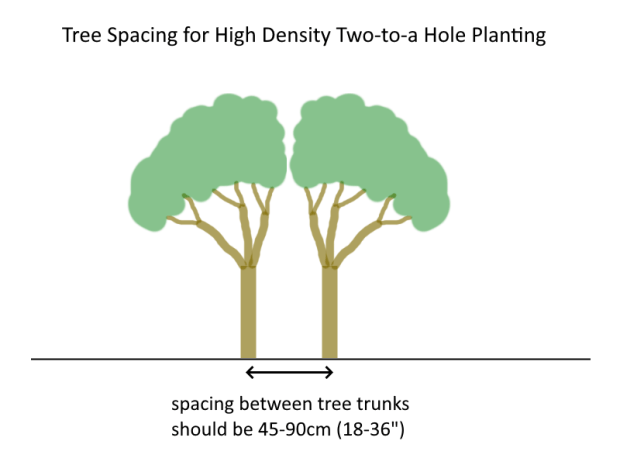
Small trees on standard rootstock; two or more trees trained as one tree. If you are interested in growing a small tree, growing two or more trees as if they are a single tree, or growing multiple fruit trees in a city lot or small yard, please buy the book Grow a Little Fruit Tree by Ann Ralph. It explains in detail the reasoning and methods for pruning trees to keep them small (on any rootstock, including standard). Because this book is such an excellent teacher, I will only summarize the main points here:
Do a severe, knee-high heading cut on the central leader immediately after planting a one-year-old bare-root tree.
Choose scaffold limbs from the resulting branched growth.
Prune in winter to remove dead, diseased, and disoriented limbs.
Prune in late June (just after the Summer Solstice) to control size, including using heading and thinning cuts.
A standard tree with lowest branches above browse height. There are some situations where the challenge of needing an orchard ladder to maintain your trees is offset by the benefits of having big trees. In areas with heavy deer pressure, trees need to grow large enough to keep tender growing tips and fruit out of reach as quickly as possible (before the temporary deer fencing wears out). The same is true in areas where livestock are expected to graze. Some people prefer a tree they can walk under, or have a narrow area where the tree must grow up before spreading wide. We may want a fruit tree to provide shade to cool the western side of a house in our increasingly hot summers, especially when we aren’t sure if electrically-powered air conditioning will remain an option as capitalism continues to collapse. Then, too, larger fruit trees create more fruit.
Yes, it is more work all year round to care for a large fruit tree. Getting on a ladder to do pruning, fruit thinning, and harvest requires more time and commitment. But if our apple trees will eventually be the source of apple sauce, apple cider, apple leather, and dried apple slices (as well as fresh eating and cooking), more fruit may be better. How will we feed our neighborhoods when the grocery stores are empty? This is not a rhetorical question. Being a “first world nation” will not long protect us from climate-chaos food shortages and famines. We must prepare to rely on local food sources.
If you have the room for it, consider planting and tending trees who have the potential to become abundant grandmothers. Whether you have the room for large trees or not, learn how to preserve local produce for later winter meals. It takes years to set in place the foundation to counteract global food shortages. Let’s not wait until our families are desperate.
If you want a clear trunk with branches beginning above your head (or above browse height for the livestock who will graze in the orchard), the early shaping methods are different than those advocated by Grow a Little Fruit Tree. First, do not do any initial heading cuts at planting time. Allow the tree to grow until ki is taller than the lowest desired scaffold branches, then do your heading cut just above this “lowest branch” height. Don’t wait too long! You want the diameter of the trunk to be small enough to cut through with pruning sheers where you do the heading cut. If you wait until the trunk needs loppers or a saw, you are doing too much damage to your young tree.
Along with heading back your young tree to about 4-6 feet (or wherever you want the scaffold branches to emerge), you also need to limb up your young tree. This means you will cut off any limbs that grow below your desired “lowest limb” height. Remember how a tree grows: lengthening from the tips. A branch emerging from the tree at knee height will always emerge from the tree at knee height. It isn’t like a human child, whose arm begins 12 inches from the floor at birth and ends up five feet above the floor after growing. If you don’t want a knee-high branch, you will have to cut it off—preferably when it is small, to create an easier-to-close wound.
After heading back and choosing scaffold branches, move on to pruning to the desired shape (open center or central leader). Do most of your pruning in the winter to encourage enthusiastic growth in response. Like size-control pruning, you will remove dead, diseased, and disoriented limbs. Unlike size control pruning, you will also use your winter pruning time to head back the tips of growing branches. Generally speaking, we can expect to cut half the new growth off every branch tip every winter for the first five to ten years. When done in winter, this doesn’t slow the tree’s growth, but it does encourage stout healthy limbs that can bear the weight of harvests to come. It also gives you scionwood that you can share with others to help establish more apple trees. (See my handout, Conversation Basics, for more on pruning cuts and the tree’s responses.)
Use weights and spacers to open crotch angles and help the tree develop a strong foundational shape. You can place these any time of year. After 1-6 months in place (depending on the time of year), the tree will have formed new woody tissue to hold the new branch angle. You can then remove the weights or spacers, and enjoy a more open tree form.
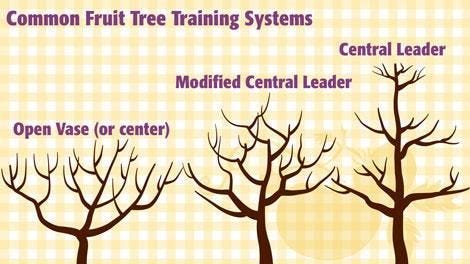
Open center and central leader. These are the two basic shapes that people have in mind when pruning and shaping young trees. Sometimes we begin with one in mind, but the tree has other ideas. Have your own opinions and goals, but listen to your trees, too.
The major difference is in how the tree relates to the sunlight coming in. Open center trees are widest at the top, and they collect sunlight throughout the branch structure. Central leader trees are widest at the bottom (like a Christmas tree), and they collect sunlight from the outside of the tree (the tips of the branches). The difference is one of personal preference (both yours and the tree’s), so I won’t try to sway you either way. There are lots of resources on how to prune to both these shapes.
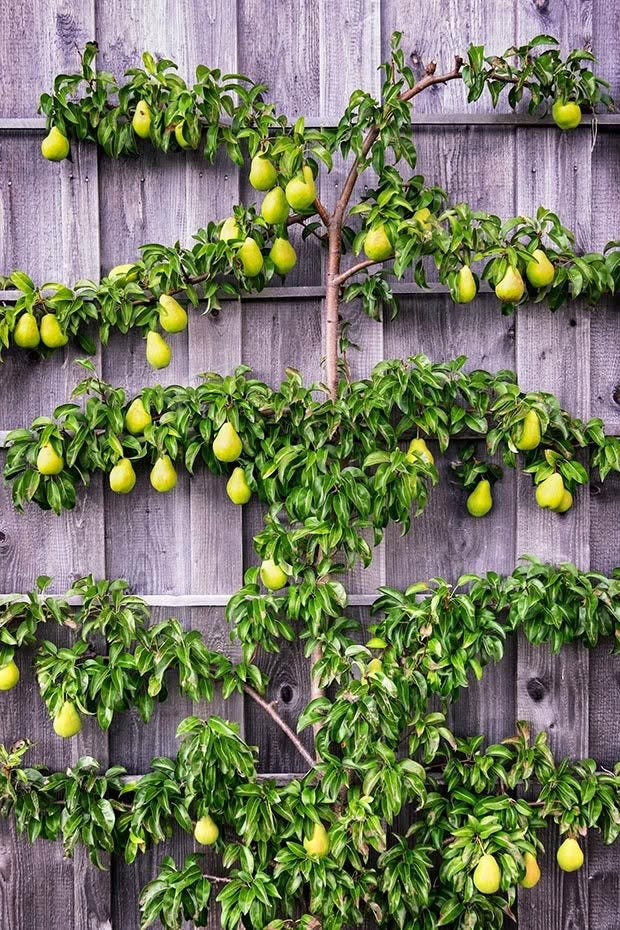
Espalier. An espalier is a tree trained to grow in a two-dimensional plane. The early training required to accomplish this is more intensive than other tree forms. You really must understand how the tree is likely to respond to your side of the pruning conversation. You have to be ready to act more quickly once the tree says something new (any new growth the tree develops). You need to be able to predict what a small new branch will become, and make corrections while the growth is young.
In some situations, this extra work is well worth it. Espaliers can be trained to grow against a fence or wall where there would be no room for a three-dimensional tree form. Multiple varieties can be grown in tight rows along wires, either in an open available space, or as a boundary planting along a property line. Espaliered trees do require support from a trellis or wall. When grown against a wall, you may be able to take advantage of a microclimate from heat reflected off the building to grow trees whose usual habitat would be farther south. After the difficult work of training young trees is complete, established espaliers are extremely easy to care for and prune.
I don’t generally recommend starting with espaliers, because small mistakes can have lasting consequences. On the other hand, the worst that can happen is that you may need to rip out some trees and start over—a result that follows from errors with other forms of fruit tree management, too. If espaliered trees are your thing—if you look at an established espalier and say, “Yes!! That!! I must have that in my garden!”—then don’t let anything stop you. Get the best advice you can, and get to work. Once your trellis is erected and the tree’s scaffold limbs are in place, you should have no trouble maintaining an established espalier.