What Can I Do? WWOOF!
Gain some real skills to survive collapse.

Before I begin, I must confess: I have never WWOOFed.
WWOOF stands for World-Wide Opportunities on Organic Farms. I’m a farmer, which means I’m tied to the land. I can’t easily visit someone else’s bioregion for a week, a month, or a year.
Perhaps you can.
Six years ago, my farm partner died suddenly in a car accident. In the haze of my grief, I somehow noticed that it was time to sow tomato seedlings. Soon I would need to turn the soil. As Spring progressed, I faced long hours of daily weed whacking. I couldn’t do this alone.
I asked my intentional community if I could have a work trader.
If you’ve never lived in community, this is how it goes: You ask a group of people for something that nobody has considered before, then you listen while they bring up all the reasons it may or may not work. Some people are excited about it right away; others are scared about how it will change things in their home. Some people trust you. Others are suspicious about your motives or worried that you will make mistakes that impact them. If you are patient and address their concerns, they might all agree to your idea—which is necessary for you to move forward, because you are making decisions by consensus.
They agreed to a work trader, as long as it was only one person (or couple) at a time, but they did not agree to allocate any housing. The work-trader had to bring their own RV, tent, or tiny house on wheels. They could stay for up to a year, and they had to be interviewed by the entire community—in person—before arriving.
I accepted their conditions. I got on the WWOOF website and made a host profile. I had to turn many people away because they didn’t have their own housing, or they lived out of state and thus couldn’t come to an in-person interview. But we did have work-traders, off and on, to help me on the farm.
“You need to teach more. We need to get you more WWOOFers. The world needs you to do this.”
Four years later, my community asked me to expand the WWOOFer program. They offered a small house for accommodations. They agreed that a single resident could interview applicants remotely, over Zoom. Several residents offered support labor, but they expected me to be the lead. With one work-trader, I could guide independent work. With four WWOOFers, each staying as short as three weeks, I would need to teach continuously.
If you’ve never lived in community, this is how it goes: The group you live with has an idea you have never considered before. It’s a good strategy; everyone agrees to it with less discussion than usual. You can see that this plan will be good for the community. To make this idea manifest, they need you to do something that will significantly change your life. You can say no, but then you will be the one blocking consensus. Do you trust the group mind, even when it requires you to step into responsibilities you never considered taking on?
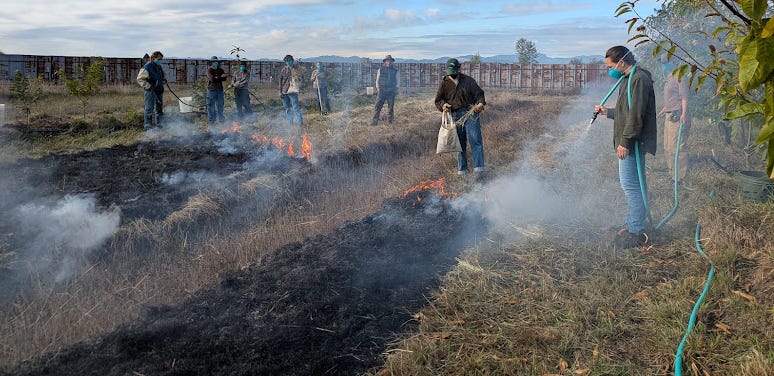
—Photo: WWOOFers and volunteers assist with a prescribed burn at Heart-Culture.—
WWOOFers begin their day with morning animal chores while I get my daughter off to school. Then we stand in a circle and I read an inspiring poem, often by Mary Oliver. I describe the tasks of the day, and we gather tools. We labor together for four or five hours. Lunch break means the end of the work day for WWOOFers—mostly. Once a week they cook community dinner, and the animals must be cared for in the evening. On weekends I teach Permaculture classes; WWOOFers can attend for free.
Other farm hosts will have different schedules and policies, but the WWOOF program internationally sets standards: WWOOFers work 25 hours per week in exchange for food, housing, and education. They pay $40 per year for access to the website that allows them to connect with host sites, schedule visits, and leave reviews.
If you don’t plan to travel, you could set up a WWOOF profile to seek out farms in your local area. Our host profile says we only accept WWOOFers for a minimum stay of 3 weeks. But when people contact me to say they live in our nearby town and would like to come out for a single day, or for one day each week, we include them. This is an excellent way to connect with local farmers and build rural community networks.
What does a “day WWOOFer” do? It depends on the season. In March, they arrive at 6 am to milk the sheep before outdoor work. As we’re laboring in the vegetable garden, my alarm goes off, and I ask an experienced WWOOFer to take the day visitor with them to bottle feed the lambs. We have a closing circle to say goodbye at 11 am.
In November, we preserve the harvest. Our work day begins at 8:30: some WWOOFers crack walnuts on the couch, while others cut up quinces to make jelly. We sterilize canning jars and stir hot pots on the stove, all with a backdrop of friendly chatter and music.
The young adult WWOOFers who come to our farm as their fifth or seventh or tenth host site have a remarkable capacity to work hard, stay focused, integrate new information, and connect socially with people of all ages and backgrounds. I intentionally foster those skills in my first-time WWOOFers, and I want those traits in my children.
We live in interesting times. For the first time in history, the majority of people post-collapse will know nothing about subsistence farming. What will they do when the grocery shelves empty? More people need to visit farms—to work, not just to gawk—to build the skills necessary for survival.